Investigating the Gap between the Expectations of Job Seekers and Hiring Managers
Thumbnail
Thumbnail

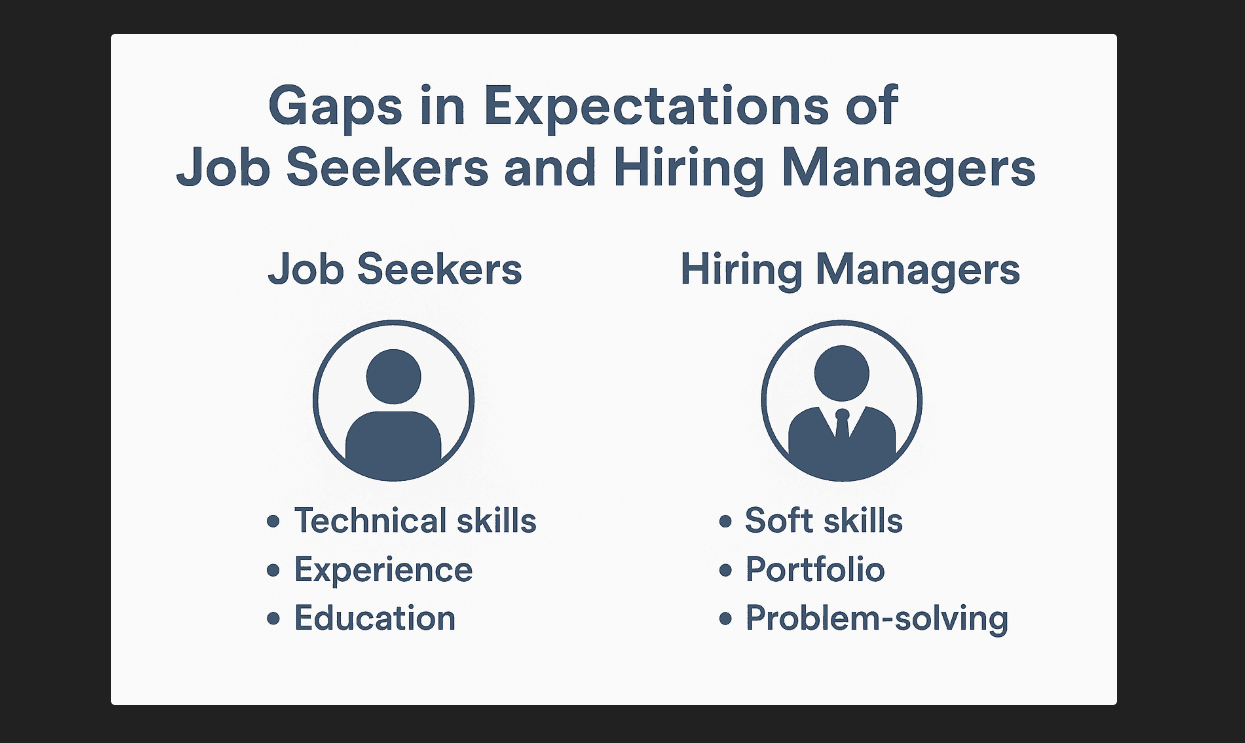
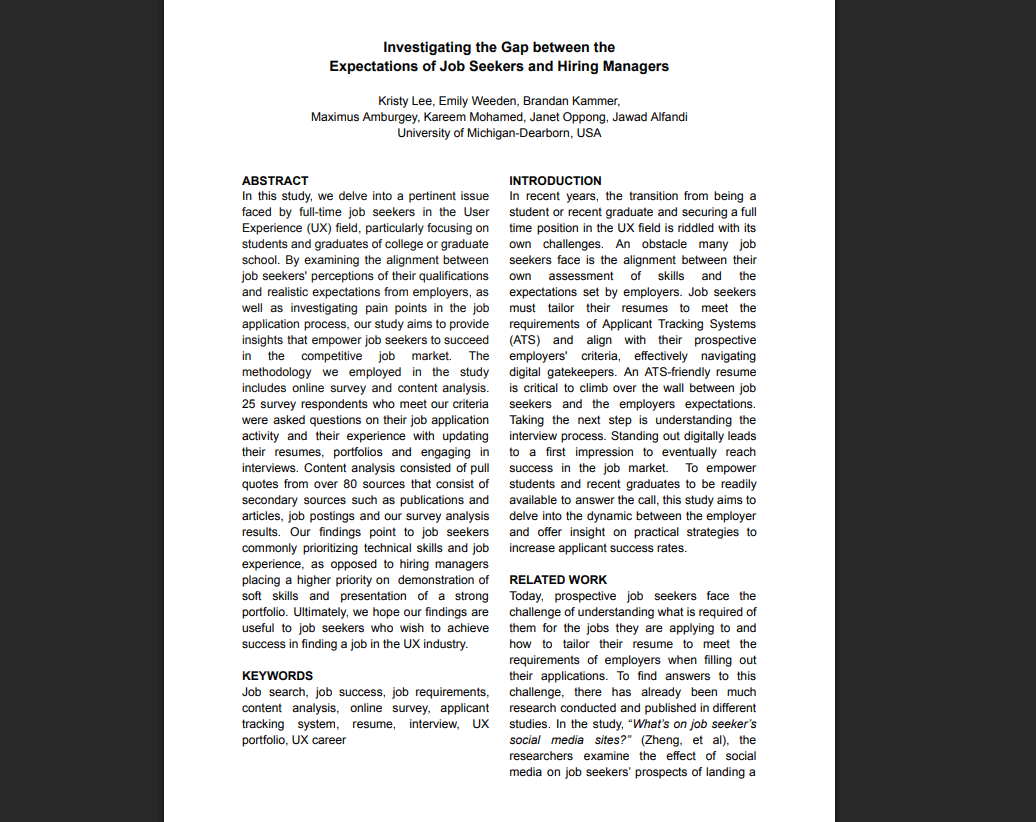
As part of my Master’s program in Human-Centered Design and Engineering at the University of Michigan–Dearborn, I collaborated on a research project exploring the disconnect between UX job seekers and hiring managers. The study focused on understanding the misalignment between what job seekers believe employers want and what employers actually value during the hiring process. To investigate this, our team conducted a mixed-methods study combining online surveys and content analysis of over 80 secondary sources—including job postings, industry articles, and UX hiring data. Our goal was to uncover practical insights that would help new UX professionals better position themselves in a competitive job market.
img
img

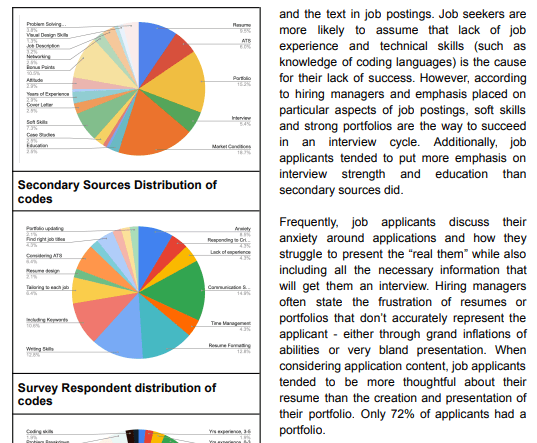
Using Google Forms, we gathered survey data from 25 participants, mostly early-career UX professionals and students. We examined their experiences with resumes, portfolios, and interviews, while also analyzing hiring trends and language from real job postings on platforms like LinkedIn and Indeed. The findings revealed that job seekers tend to overemphasize technical skills and experience, while hiring managers prioritize communication skills, collaboration, and the presentation of a strong portfolio. Interestingly, anxiety and uncertainty about resume formatting and self-presentation emerged as major pain points among participants, highlighting an emotional dimension often overlooked in UX career guidance.

Using Google Forms, we gathered survey data from 25 participants, mostly early-career UX professionals and students. We examined their experiences with resumes, portfolios, and interviews, while also analyzing hiring trends and language from real job postings on platforms like LinkedIn and Indeed. The findings revealed that job seekers tend to overemphasize technical skills and experience, while hiring managers prioritize communication skills, collaboration, and the presentation of a strong portfolio. Interestingly, anxiety and uncertainty about resume formatting and self-presentation emerged as major pain points among participants, highlighting an emotional dimension often overlooked in UX career guidance.

Using Google Forms, we gathered survey data from 25 participants, mostly early-career UX professionals and students. We examined their experiences with resumes, portfolios, and interviews, while also analyzing hiring trends and language from real job postings on platforms like LinkedIn and Indeed. The findings revealed that job seekers tend to overemphasize technical skills and experience, while hiring managers prioritize communication skills, collaboration, and the presentation of a strong portfolio. Interestingly, anxiety and uncertainty about resume formatting and self-presentation emerged as major pain points among participants, highlighting an emotional dimension often overlooked in UX career guidance.

img
img

Through this research, I strengthened my ability to combine quantitative data, qualitative insights, and content coding to draw meaningful conclusions from complex human behavior. Our final recommendations emphasized the importance of developing authentic, narrative-driven portfolios and showcasing soft skills throughout the application process—key differentiators for UX candidates. This project not only expanded my research expertise but also deepened my understanding of how human-centered thinking extends beyond product design to include the ways people navigate and experience career systems.

Want to view the whole project? Click here —> https://drive.google.com/file/d/1rRufjgWujIdRTpKNVrTNKazzneAxVRAm/view?usp=sharing

Through this research, I strengthened my ability to combine quantitative data, qualitative insights, and content coding to draw meaningful conclusions from complex human behavior. Our final recommendations emphasized the importance of developing authentic, narrative-driven portfolios and showcasing soft skills throughout the application process—key differentiators for UX candidates. This project not only expanded my research expertise but also deepened my understanding of how human-centered thinking extends beyond product design to include the ways people navigate and experience career systems.

Want to view the whole project? Click here —> https://drive.google.com/file/d/1rRufjgWujIdRTpKNVrTNKazzneAxVRAm/view?usp=sharing

Through this research, I strengthened my ability to combine quantitative data, qualitative insights, and content coding to draw meaningful conclusions from complex human behavior. Our final recommendations emphasized the importance of developing authentic, narrative-driven portfolios and showcasing soft skills throughout the application process—key differentiators for UX candidates. This project not only expanded my research expertise but also deepened my understanding of how human-centered thinking extends beyond product design to include the ways people navigate and experience career systems.

Want to view the whole project? Click here —> https://drive.google.com/file/d/1rRufjgWujIdRTpKNVrTNKazzneAxVRAm/view?usp=sharing

Create a free website with Framer, the website builder loved by startups, designers and agencies.